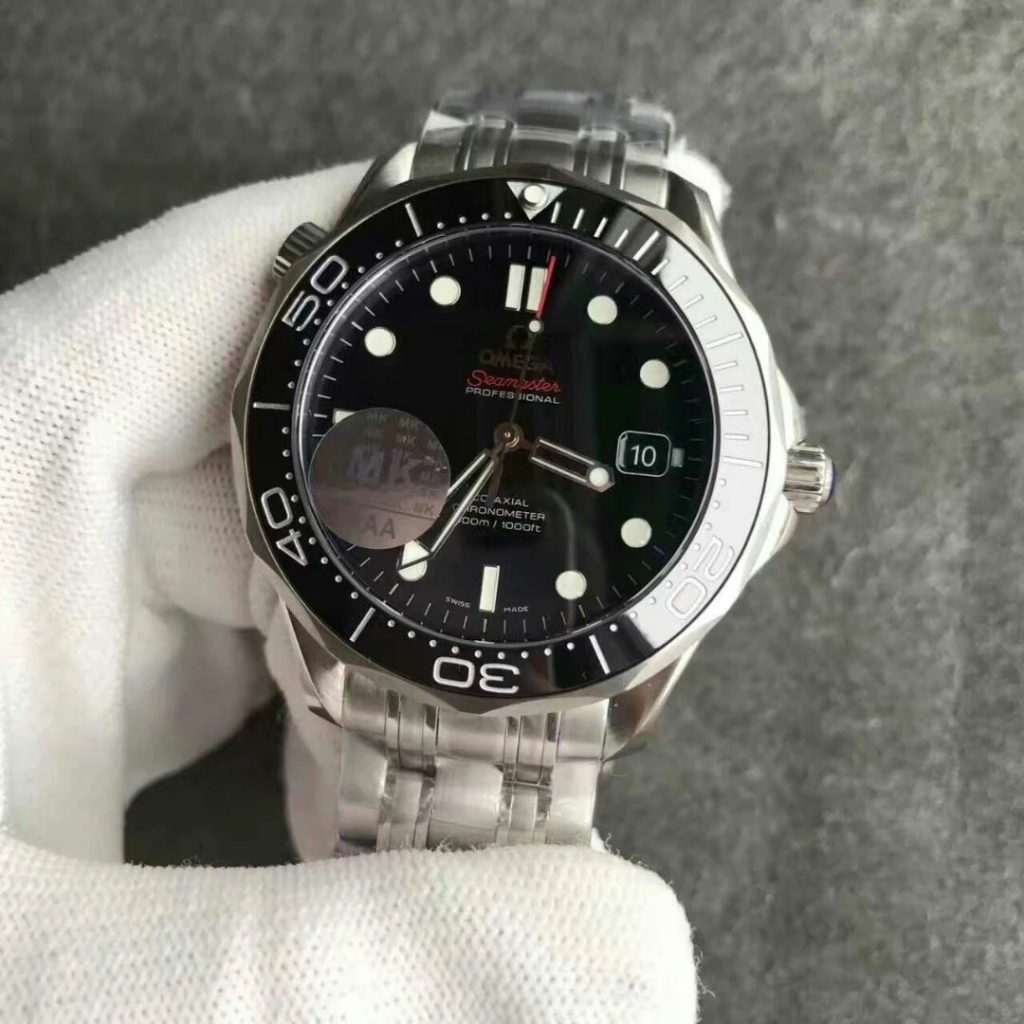

The Seamaster 300 name carries a long history, which is why a product labelled simply ‘Omega Seamaster 300 ceramic’ needs careful identification. The archive pictures illustrate a dark dial with prominent markers and a ceramic-looking bezel. They are useful for evaluating the design, but a manufacturer or workshop name in a caption does not establish a technical specification.
A Seamaster 300 replica bezel and dial comparison works best with a specific genuine reference beside it. Distinct Seamaster families have different case geometry and dial treatments. Before calling a detail accurate, identify whether the image is intended to resemble a heritage-style Seamaster 300 or the Diver 300M family.

Contrast and proportions
The bezel creates a frame around the watch face. From the photographs, examine the apparent alignment of the markings and the way the crystal meets the outer edge. The hands and hour plots provide the principal legibility test. Uneven spacing can be visible in a straight-on shot, while side images are better for discussing case height and crown placement.
Descriptions that promise ‘ceramic’ or a specific clone movement require evidence beyond appearance. A glossy bezel can resemble ceramic regardless of its underlying construction. The same applies to stated water resistance: it cannot be concluded from the name of a diver’s watch or from a product photo.

The article now places the example in the Omega model reference archive rather than an unrelated brand category. The watch publication homepage remains a separate navigation path for readers exploring Rolex and Breitling.

Ceramic surfaces also interact with light differently from painted metal, but that difference cannot always be judged from a compressed web image. A responsible editorial comparison uses photographs to identify the location and shape of glossy elements, then explicitly withholds a conclusion about composition. A case-back photo may show an engraved pattern, yet engraving alone cannot establish which movement or seals sit beneath it.

The strongest conclusion is a visual one. The design depends on a restrained dial, easily read hands and a compact bezel profile. Those features can be assessed from the archive; mechanical and material claims remain unverified.